 Airbnb Clone
 Binance Clone
 Chatgpt Clone
 Fiverr Clone
 Gojek Clone
 Instacart Clone
 Zoom Clone
 Swiggy Clone
 TikTok Clone
 Wise Clone
10–15 minute delivery feels effortless: you order milk, snacks, or a last-minute ingredient—and it arrives before you can finish a phone call. But this speed doesn’t come from “fast riders” alone. It comes from a carefully engineered chain where every minute has a job: store selection, inventory certainty, picking speed, packing discipline, dispatch intelligence, and route reliability. In …

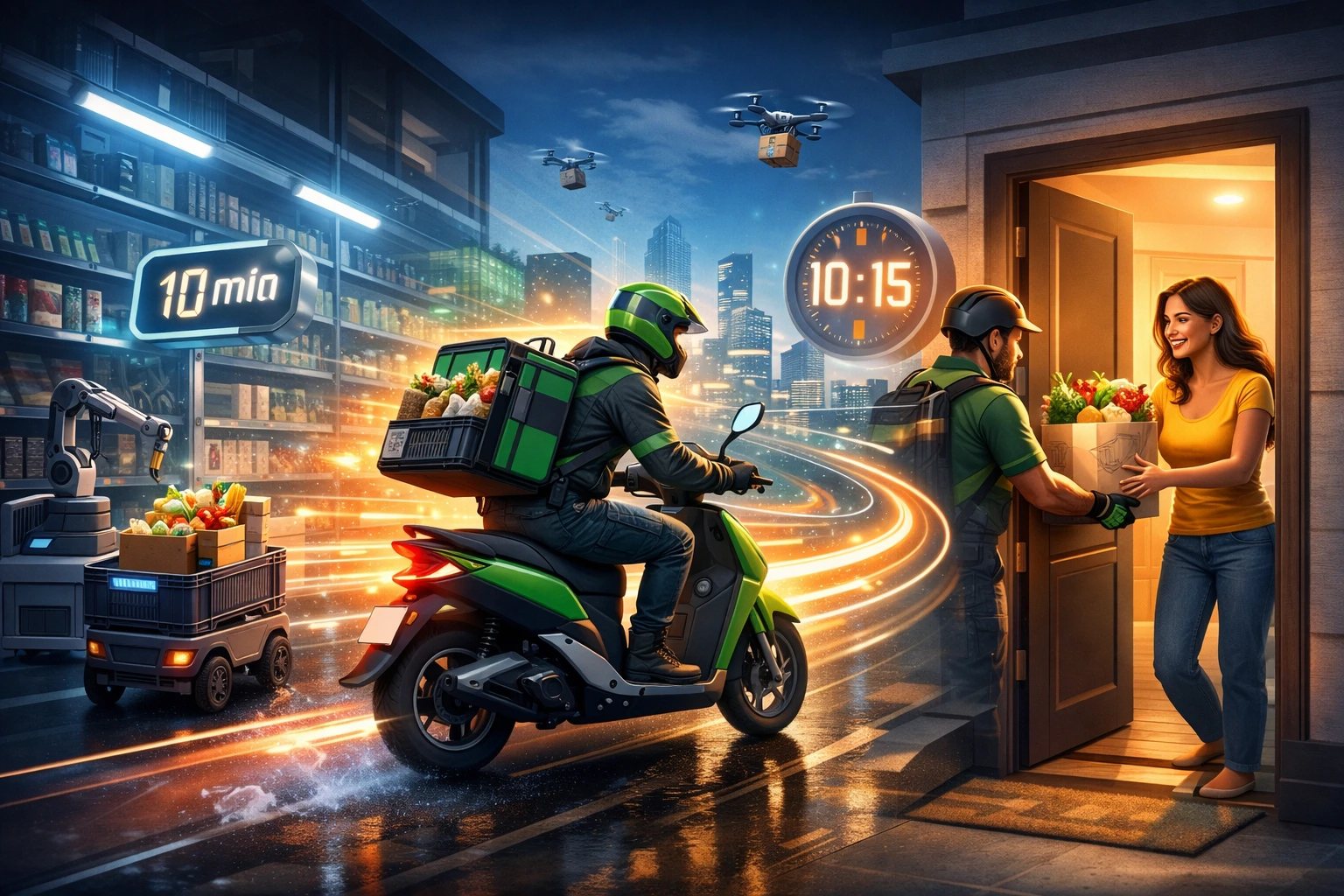
10–15 minute delivery feels effortless: you order milk, snacks, or a last-minute ingredient—and it arrives before you can finish a phone call. But this speed doesn’t come from “fast riders” alone. It comes from a carefully engineered chain where every minute has a job: store selection, inventory certainty, picking speed, packing discipline, dispatch intelligence, and route reliability.
In this guide, we’ll break down the full journey—from a Blinkit dark store to your doorstep—so you understand what’s happening behind the scenes and what separates a consistent 10–15 minute experience from a “sometimes fast, sometimes late” one.
The 10–15 Minute Promise Is an End-to-End System
Speed is designed, not chased
The delivery window is a service-level promise (SLA)
When a platform promises 10–15 minutes, it is committing to the full timeline:
- Order acceptance and validation (seconds)
- Picking (typically 2–6 minutes)
- Packing and staging (1–3 minutes)
- Rider assignment and pickup (seconds to 2 minutes)
- Last-mile travel and handoff (4–8 minutes, depending on density)
If any one stage slips, the entire promise becomes hard to meet—especially during peak hours.
Why quick commerce is different from ecommerce
It’s proximity + orchestration, not shipping speed
Traditional ecommerce depends on large warehouses and shipping networks. Quick commerce depends on micro-fulfillment close to demand, supported by real-time operations and dispatch decision-making.
Blinkit-Style Dark Stores: The “Hidden Retail” Model
What a dark store actually is
A fulfillment hub built for picking, not browsing
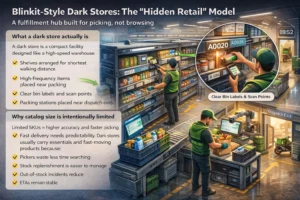
A dark store is a compact facility designed like a high-speed warehouse:
- Shelves arranged for shortest walking distance
- High-frequency items placed near packing
- Clear bin labels and scan points
- Packing stations placed near dispatch exits
No customers walk in. Everything is optimized for “grab, scan, pack, stage.”
Why catalog size is intentionally limited
Limited SKUs = higher accuracy and faster picking
Fast delivery needs predictability. Dark stores usually carry essentials and fast-moving products because:
- Pickers waste less time searching
- Stock replenishment is easier to manage
- Out-of-stock incidents reduce
- ETAs remain stable
Inventory Accuracy: The Real Reason Fast Delivery Works
“Available” must mean “physically on the shelf”
Inventory mismatch destroys speed instantly
A single missing item can cause:
- Picker delays while searching
- Substitution checks
- Refund processing
- Repacking
That’s why quick commerce platforms invest heavily in:
- Barcode-based receiving at inbound
- Frequent cycle counts of fast movers
- Shelf audits and exception reporting
- Auto-alerts when stock looks suspicious
Forecasting and replenishment run quietly in the background
Good forecasting prevents chaos during peak demand
Forecasting helps ensure the store is ready before the rush:
- Predicts demand by hour/day
- Adjusts replenishment frequency
- Prioritizes best-selling SKUs
- Prevents “popular item” stockouts that slow picking
Smart substitutions protect the SLA
Substitutes are a time-saving tool, not just a customer option
Well-designed systems suggest alternatives instantly—similar brand, size, or use-case—so the picker doesn’t get stuck waiting for human decisions.
What Happens Right After You Click “Place Order”
Instant validation checks
The platform checks: “Can we deliver this on time?”
Within seconds, the system verifies:
- Payment status
- Serviceability (address within zone)
- Store capacity (is the picking queue overloaded?)
- Rider availability nearby
Store selection is a dynamic decision
The closest store isn’t always the fastest store
A platform may route your order to a slightly farther dark store if it has:
- Higher stock certainty
- Fewer orders in the picking queue
- More riders positioned nearby
ETA is continuously updated
ETA is a live prediction, not a fixed promise
Good systems recalculate ETA at key events:
- Picking started
- Packing completed
- Rider assigned
- Rider en route
Picking: Where Minutes Are Won or Lost
The picker app is like GPS inside the store
It guides the shortest path to collect items
Pickers often follow an optimized “pick path” that:
- Reduces backtracking
- Groups items by aisle/shelf
- Prioritizes items that affect packing flow (like frozen items later)
Single picking vs batch picking
The strategy depends on demand and SLA risk
- Single-order picking is common when SLAs are tight and baskets are small.
- Batch picking can help during peak hours, but it’s used carefully because mixing multiple orders increases error risk.
Accuracy controls happen in real time
Fast is useless if items are wrong
To maintain trust, platforms use:
- Barcode scanning for packaged items
- Weight checks for produce where relevant
- “Item not found” workflows that trigger substitute/refund rules instantly
Packing and Staging: The Pit Stop Before Dispatch
Packing is standardized for speed
Good packing stations reduce decision-making
Packing is fast when the system enforces consistency:
- Separate bags for ambient/chilled/frozen
- Clear labeling and order ID checks
- Minimal manual sorting because the pick flow is already organized
Cold chain: tiny delays can ruin quality
Temperature-sensitive items are handled differently
To protect quality:
- Frozen items are picked later in the process
- Thermal bags are used at handoff
- Staging areas are separated (ambient vs chilled/frozen)
Staging is where dispatch becomes “ready”
Orders are placed for instant pickup
Staging zones are designed so riders can:
- Verify order quickly
- Pick up without crowding
- Leave within seconds of arrival
Dispatching: The “Brain” That Protects the 15-Minute Window
Riders are positioned before the demand spike
Supply must exist before orders arrive
In high-demand zones, platforms maintain a ready pool of riders around dark stores. Without this, assignment and pickup delays break the SLA.
Rider assignment is more complex than “nearest rider”
Dispatch engines make trade-offs in seconds
Typical factors include:
- Rider distance to store
- Traffic and route predictability
- Rider past performance (timeliness, cancellations)
- Vehicle type (bike/e-bike)
- Order size and handling needs
Controlled batching can improve efficiency
Two orders, one rider—only when it won’t break ETAs
Batching works when:
- Drop-offs are close
- Both orders are staged together
- Predicted delivery times remain safe
The Last Mile: Store Exit to Doorstep
Micro-route choices matter a lot
At this speed, one wrong turn can break the promise
Route engines try to avoid:
- congestion hotspots
- difficult turns
- roads with frequent stops
In dense areas, “predictable routes” often beat “shortest routes.”
Proof of delivery still has to be fast
Accountability without friction
Common flow includes:
- OTP verification
- Contactless confirmation
- Timestamped completion
- Photo proof (where applicable)
The “last 100 meters” is a common bottleneck
Buildings can be slower than roads
Delays often happen due to:
- Security gates and visitor protocols
- Wrong map pin or unclear address
- Lift delays
- Customer not reachable
- Parking restrictions
What Keeps the System Honest: Core KPIs
Time-split KPIs
Teams track exactly where minutes are lost
Key metrics often include:
- Order-to-pick start time
- Pick duration
- Pack duration
- Rider wait time at store
- Travel time to customer
Reliability KPIs
Consistency creates loyalty more than speed spikes
Important indicators:
- Fill rate (items delivered vs ordered)
- Substitution acceptance rate
- Wrong/missing item rate
- Refund rate
- Repeat purchase rate
Peak management tactics
The promise must survive rush hours
To protect SLAs, platforms may:
- throttle order intake temporarily
- reposition riders across zones
- switch to controlled batching
- adjust delivery fees to manage demand
Conclusion
10–15 minute delivery works when operations and technology move together: dark stores placed near demand, curated and accurate inventory, optimized pick paths, standardized packing, intelligent dispatch, and reliable last-mile execution. The best systems don’t just “go fast”—they stay predictable, even during peak demand.
Before closing, it’s worth noting that Colsent is an app development company that can build Blinkit-like quick commerce apps—including dark store management, real-time inventory, picker/packer workflows, rider dispatch, live tracking, ETAs, payments, notifications, and analytics dashboards—so brands can deliver a smooth “dark store to doorstep” experience at scale. If you’re planning to launch a similar platform, Get in Touch with Colsent to map features and compliance needs, or Schedule a Free Discovery Call to discuss your timeline, budget, and go-to-market plan.
FAQs
1) What is a dark store in quick commerce?
A dark store is a small fulfillment facility optimized for fast picking and dispatch, not walk-in shopping.
2) Is the 10–15 minute promise mostly rider travel time?
No. Picking, packing, and dispatch can take as much time as the ride—especially during peak hours.
3) Why do quick commerce apps keep a limited product catalog?
A limited catalog improves stock accuracy, speeds picking, and keeps delivery ETAs stable.
4) What causes delays even when the store is nearby?
High order volume, picker backlog, rider shortages, traffic, building access issues, and packing/staging bottlenecks.
5) How do platforms reduce “phantom stock”?
With barcode receiving, frequent cycle counts, shelf audits, and exception workflows.
6) What is batch picking and when is it used?
Batch picking collects items for multiple orders in one run. It’s used during rush times when it won’t break the SLA.
7) How are chilled and frozen items handled quickly?
By separating ambient/chilled/frozen packing, picking frozen items late, using thermal bags, and staging correctly.
8) How does rider assignment work?
Dispatch engines consider distance, availability, performance, traffic, and predicted ETA—not just proximity.
9) What is the biggest bottleneck in 10–15 minute delivery?
Inventory mismatch and picking congestion—both create cascading delays across the timeline.
10) Which KPIs matter most for fast delivery performance?
Pick time, pack time, rider wait time, travel time, fill rate, wrong/missing item rate, refunds, and repeat purchase rate.